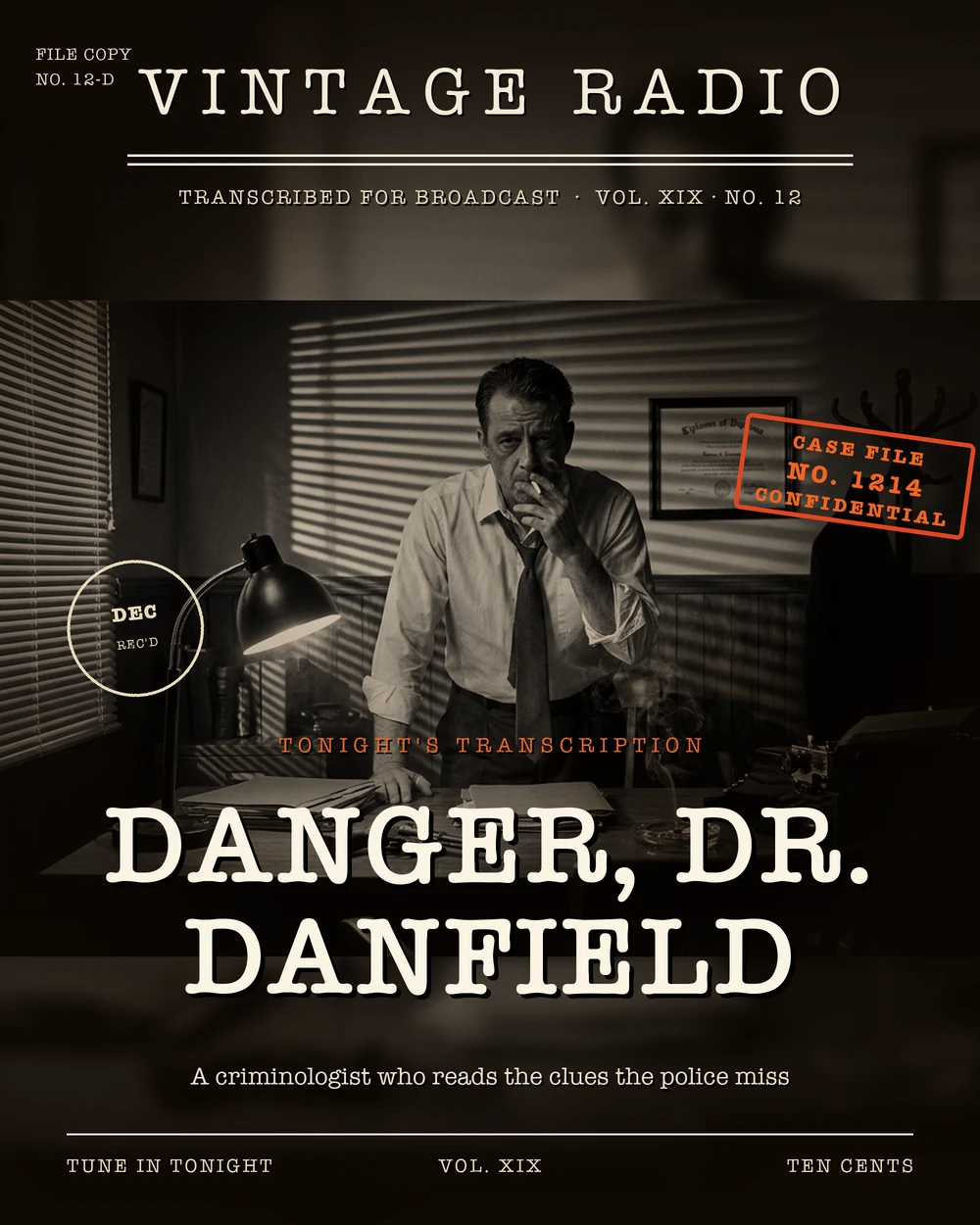
Danger, Dr. Danfield
The Setup
"The human mind is like a cave," Dr. Daniel Danfield announced at the top of each episode. "Beyond the light are dark passageways and mysterious recesses. I, Doctor Daniel Danfield, have explored those unknown retreats and know their secrets." That opening monologue, delivered by Michael Dunne in his most authoritative register, set the tone for what ABC was offering Sunday afternoons in the late summer of 1946 — a crime show whose hero wasn't a hardboiled private eye or a beat cop but a criminal psychologist, picking apart cases with the cool analytical air of a man who had read his Freud.
The show premiered August 18, 1946, ran thirty minutes, and aired Sundays at 3 PM before shifting to 2 PM. Wally Ramsey produced; Ralph Wilkinson wrote. The series was pre-recorded — a transcribed production from Teleways Radio Productions, which meant ABC was buying a finished package rather than mounting the show live in-house. The trade publication Shows of Tomorrow, issued by Radio Daily, summarized the program's pitch neatly: "emphasis on solution of crime rather than on murder."
Danfield and Rusty
Each episode opened with Danfield dictating the summary of a closed case to his secretary, Rusty Fairfax, played by Jo Anne Johnson. Rusty was pert and sassy — characterized as the sort who usually had too much to say and said it badly. Dramatic sequences played out inside the narration, and the show followed a rigid three-act formula: the crime was committed in the first third, Danfield solved it in the second, and then he pedantically explained the solution — usually to Rusty — in the final third. The structure was tidy to the point of mechanical, and modern OTR commentators have not been kind about it. The series has been described as "consistently featured some of the worst acting and writing of any detective show to reach the airwaves," and a contemporary reviewer quoted by the Radio Classics website went further, dubbing it "one of the worst detective shows ever to curse the ABC airwaves."
The supporting cast was more interesting than the leads. Herb Butterfield played the recurring role of Captain Otis, a homicide detective; Butterfield was a widely employed character actor whose other credits included crime-lab expert Lee Jones on Dragnet and The Commissioner on Dangerous Assignment. Jay Novello played Danfield's chauffeur Mario, a working-class Italian character who, by one description, sounded like Chico Marx. Novello was one of the busiest character men in radio, with credits including Jack Packard on I Love a Mystery and Captain Sam Sabaaya on Rocky Jordan. Howard McNear turned up in at least three episodes. The production economy showed in the sound design: minimal effects, with an organist providing all the music for every episode.
The Run and the Cancellation
The ABC network run lasted from August 18, 1946 through April 13, 1947 — just under eight months and exactly twenty-six episodes. The trade-press indifference and the contemporary critical drubbing caught up with the show, and ABC pulled it that April. But the transcribed format meant the episodes had a life beyond cancellation. Syndicated reruns aired on WMGM in New York from roughly 1949 to 1951, and on the Mutual network around 1952. All twenty-six episodes survive — about ten hours and fifty-seven minutes of programming total — preserved through a certified set and the Joe Hehn Memorial Collection. Joe Hehn (1931–2020) was one of the pioneering OTR collectors who began gathering recordings in the 1960s.
The Man Behind Danfield
The most consequential thing about Danger, Dr. Danfield may be what it did for its star. Francis Michael Dunne — born January 13, 1918, in Northampton, Massachusetts — was at the start of his career when he took the role. He had studied drama and journalism at the University of Alabama for two and a half years, working at a local radio station, and had announced for WOR in New York before heading to California. Twentieth Century Fox signed him in 1945 under the billing "Michael Dunne," and his film debut came that year in Junior Miss. The radio work followed naturally, and the Danfield part landed in his lap as he was establishing himself on the West Coast.
In 1946 he appeared as Dr. Stevens in the Vincent Price film Shock, and that role caught the eye of producer William Spier — a connection that would matter later. When Danfield was cancelled in April 1947, Dunne was immediately cast in Deadline Mystery, another ABC series, playing newspaper reporter Lucky Larson; that show premiered one week after Danfield's cancellation and ran through August. Columbia Pictures picked him up in 1947 and renamed him Stephen Dunne. By 1950, Spier had come through: Dunne took over as Sam Spade on NBC's The Adventures of Sam Spade, replacing the popular Howard Duff. Radio historian Ivan Shreve noted the verdict that Dunne "sounded like Sam in knee pants" — a kinder way of saying the part fit Duff better.
Television kept Dunne working steadily for another two decades. He was a regular on CBS-TV's The Bob Crosby Show from 1953 to 1957, played Dr. Thomas Wilson in the 1955 sitcom Professional Father, and hosted game shows including You're on Your Own, Truth or Consequences in the 1956–1957 season, and Double Exposure. His final film appearance was in the Disney comedy Superdad in 1973 — a few years after his small uncredited turn as newscaster Stanley Kael in Willy Wonka & the Chocolate Factory. He died September 28, 1977, by which point he had shed Michael for Stephen and then settled on Steve.
What Survives
What's left, for the modern listener, is a complete twenty-six-episode run with the kinds of titles that telegraph the show's pulpy ambitions: "The Professor," "Death Paints a Picture," "Edgar Allen Poe Manuscript," "Legend of Windigo," "The Case of the Whirling Mirrors," "Ghost of Murdock Swamp." OTR commentators tend to place the show in the same broad family as Nick Carter, Master Detective, Casey, Crime Photographer, and The Falcon, while noting it as the weaker cousin. The criticisms aren't unfair — the formula is rigid, the explanations are pedantic, the comic relief is the kind that needs sharper writing than it got. But the show is also a useful artifact: a pre-recorded transcription series from a small production house, sold to a network, run on Sunday afternoons, cancelled when the reviews caught up with it, then quietly kept in circulation by syndication for years. That arc was as much a part of late-1940s radio economics as the marquee shows, and Danger, Dr. Danfield preserves it with all twenty-six episodes intact.